

$399K State Grant Will Fund Baylor's PEAKS+, a New Model for Sustainable Autism Training and Supports
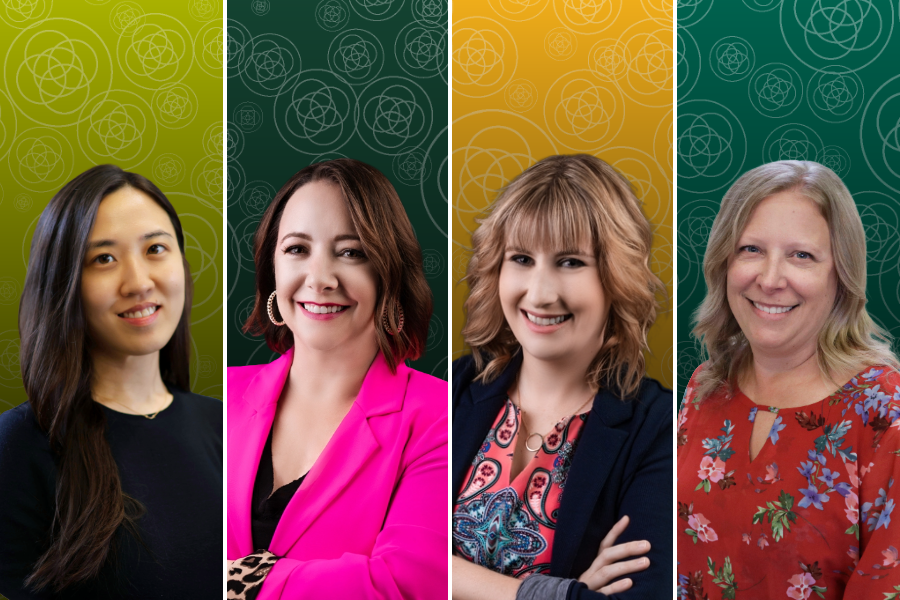
From left: Dr. Gospel Kim, Dr. Tonya Davis, Dr. Jessica Akers, and Dr. Jenny Robins, the Baylor faculty team leading the PEAKS+ initiative to support Texas educators serving students with autism.
Educators across Texas are facing growing demand to support students with autism, often without access to sustained, evidence-based professional development. A new Baylor University initiative aims to close that gap, equipping teachers with strategies they can put to use immediately while building longer-term capacity within their schools.
The project, "Preparing Educators with Autism Knowledge and Skills Plus (PEAKS+): A Model for Sustainable Practice," is funded by a two-year, $399,367 grant from the Texas Higher Education Coordinating Board Autism Grant Program. Dr. Gospel Kim, assistant professor of educational psychology, leads the collaborative team, which includes Dr. Tonya Davis, professor; Dr. Jessica Akers, associate professor; and Dr. Jenny Robins, clinical associate professor, all in Baylor's Department of Educational Psychology.
Meeting an Urgent Need in Texas Schools
Special education teachers and general educators alike are increasingly responsible for serving students with autism and other developmental disabilities, often with little training beyond initial certification. Kim said PEAKS+ was designed to close that gap in a way that is both practical and sustainable.
"This is professional development that we are providing in partnership with community and school districts," Kim said. "We are trying to empower teachers not only to address students' behavior needs, but also to teach the core skills students need to be successful in school."
The project centers on two well-established, evidence-based practices: RUBI in Educational Settings (RUBIES; Bearss et al., 2022), which helps educators address challenging behaviors, and Classroom Pivotal Response Training (CPRT; Stahmer et al., 2016), which builds foundational skills like communication, engagement and motivation. Together, the two approaches push teachers past short-term behavior management and toward the kind of skill-building that supports students over the long haul.
Intentional Support for Twice-Exceptional Learners
PEAKS+ also makes a point of reaching students with twice exceptionalities — learners who have both a learning exceptionality and a disability. That combination often leaves them overlooked in traditional service models.
"Implementation itself is a skill, and many teachers can benefit from ongoing support to apply what they learn." - Dr. Gospel Kim
"There may be additional layers of need for these students," Kim explained. "They are often not fully captured within existing school systems or services, so one of our goals is to support populations that are frequently overlooked."
Robins brings specific expertise in this area, giving the interdisciplinary team the depth it needs to address students whose strengths and challenges coexist.
A Three-Phase Model Built for Real Implementation
PEAKS+ skips the one-time workshop model in favor of three phases of sustained support — a structure grounded in research showing that knowledge alone rarely translates into classroom practice.
"We know from research that simply delivering knowledge does not necessarily translate into effective classroom implementation," Kim said. "Implementation itself is a skill, and many teachers can benefit from ongoing support to apply what they learn."
Phase One consists of structured workshops delivered in partnership with regional education service centers, giving educators a shared foundation in evidence-based strategies. Phase Two moves online, offering asynchronous group consultation where teachers work with peers and faculty consultants to problem-solve and refine their practice. Phase Three is the most intensive: hybrid coaching, delivered virtually and in person, in which faculty members and trained consultants give individualized feedback inside teachers' own classrooms.
The tiered design lets educators engage at whatever level fits their needs and availability, while still offering deeper support to those who want it.
Extending Impact Across Educators and Students
Over the life of the grant, the PEAKS+ team expects to reach roughly 270 educators across multiple cohorts — and, through them, an estimated 1,350 students statewide.
"Our goal is not only the number of teachers we train, but also the number of students we ultimately reach through those teachers," Kim said.
Partnering with regional education service centers lets the project draw on existing relationships, extending Baylor's reach well beyond campus and strengthening ties with local schools and districts.
Graduate Students Gaining Real-World Experience
As with much of the work in the Department of Educational Psychology, PEAKS+ builds graduate assistants into its design. Funded research assistant positions let students apply their training in school-based settings, not just clinical ones.
"This is a great opportunity for graduate students to expand their experience and see themselves using their skills in collaboration with teachers," Kim said.
The hands-on involvement prepares future professionals to work in community contexts while contributing directly to better outcomes for both educators and students.
Advancing the Moody School of Education Mission
Bree Jimenez, chair of the Department of Educational Psychology, said the project reflects the broader mission of the Moody School of Education.
"PEAKS+ exemplifies our commitment to preparing professionals who serve others with excellence and purpose," Jimenez said. "By combining rigorous research, meaningful partnerships and hands-on graduate training, this work reflects Moody's vision to make a tangible difference in schools and communities."
Through PEAKS+, Baylor faculty, students and school partners are working together to ensure educators have not just the knowledge, but the confidence and support, to make a lasting difference in the lives of students with autism.
ABOUT BAYLOR UNIVERSITY
Baylor University is a private Christian University and a nationally ranked Research 1 institution. The University provides a vibrant campus community for 20,000 students by blending interdisciplinary research with an international reputation for educational excellence and a faculty commitment to teaching and scholarship. Chartered in 1845 by the Republic of Texas through the efforts of Baptist pioneers, Baylor is the oldest continually operating University in Texas. Located in Waco, Baylor welcomes students from all 50 states and more than 100 countries to study a broad range of degrees among its 12 nationally recognized academic divisions. Learn more about Baylor University at www.baylor.edu.
ABOUT MOODY SCHOOL OF EDUCATION
For more than 100 years, the Moody School of Education has advanced Baylor’s mission across the globe while preparing students for a range of careers focused on education, leadership, and human development. With more than 70 full-time faculty members, the School’s growing research portfolio complements its long-standing commitment to excellence in teaching and student mentoring. Baylor’s undergraduate program in teacher education has earned national distinction for innovative partnerships with local schools that provide future teachers deep clinical preparation. Likewise, the School of Education’s graduate programs have attained national recognition for their exemplary preparation of research scholars, educational leaders, innovators, and clinicians. Visit the Moody School of Education website to learn more.